PPE Report • September 2026 Special Newspaper Issue
Report • Regulatory & Safety Compliance

Where Workplace Safety Violations Are Still Concentrated: What OSHA's Latest Top 10 Shows

OSHA's latest published Top 10 list provides a useful snapshot of the workplace hazards most frequently cited during federal OSHA inspections for fiscal year 2025.

Fall protection remained at the top, while respiratory protection and eye and face protection also appeared among the ten most frequently cited standards.

What OSHA's FY2025 Top 10 shows

OSHA's FY2025 list places the following standards among the most frequently cited during federal OSHA inspections:

Official OSHA FY2025 Top 10 Cited Standards
  1. Fall Protection
  2. Hazard Communication
  3. Ladders
  4. Lockout/Tagout
  5. Respiratory Protection
  6. Scaffolding
  7. Fall Protection Training
  8. Powered Industrial Trucks
  9. Eye and Face Protection
  10. Machine Guarding

What does the list tell PPE professionals?

The OSHA list is more than a ranking of frequently cited standards. It also shows how workplace protection extends beyond PPE alone.

Respiratory protection and eye and face protection are directly relevant PPE categories, while fall protection demonstrates that workplace protection also depends on equipment, procedures, training and the overall safety system.

PPE cannot compensate for a weak safety system

A worker may have access to appropriate PPE and still face significant workplace risks if hazards are not properly identified, controlled and managed.

OSHA's Top 10 therefore provides a useful reminder that PPE should be considered as one part of a broader hierarchy of workplace controls. Engineering controls, administrative controls, training, safe work practices and appropriate PPE all have a role in reducing workplace risk.

Why the data matters for PPE professionals

For PPE manufacturers, safety managers and occupational safety professionals, the list highlights several areas where protective equipment remains closely connected to recurring workplace hazards.

Respiratory protection and eye and face protection appear directly in the Top 10, while fall protection and other frequently cited standards illustrate the wider safety environment in which PPE is selected and used.

The bigger takeaway is that PPE should not be viewed in isolation. Effective workplace protection starts with understanding the hazard and applying the appropriate combination of controls, equipment and training.

Source: U.S. Occupational Safety and Health Administration (OSHA), “Top 10 Most Frequently Cited Standards — Fiscal Year 2025.”
View the official OSHA FY2025 Top 10 list ↗
Special Report • High-Visibility PPE

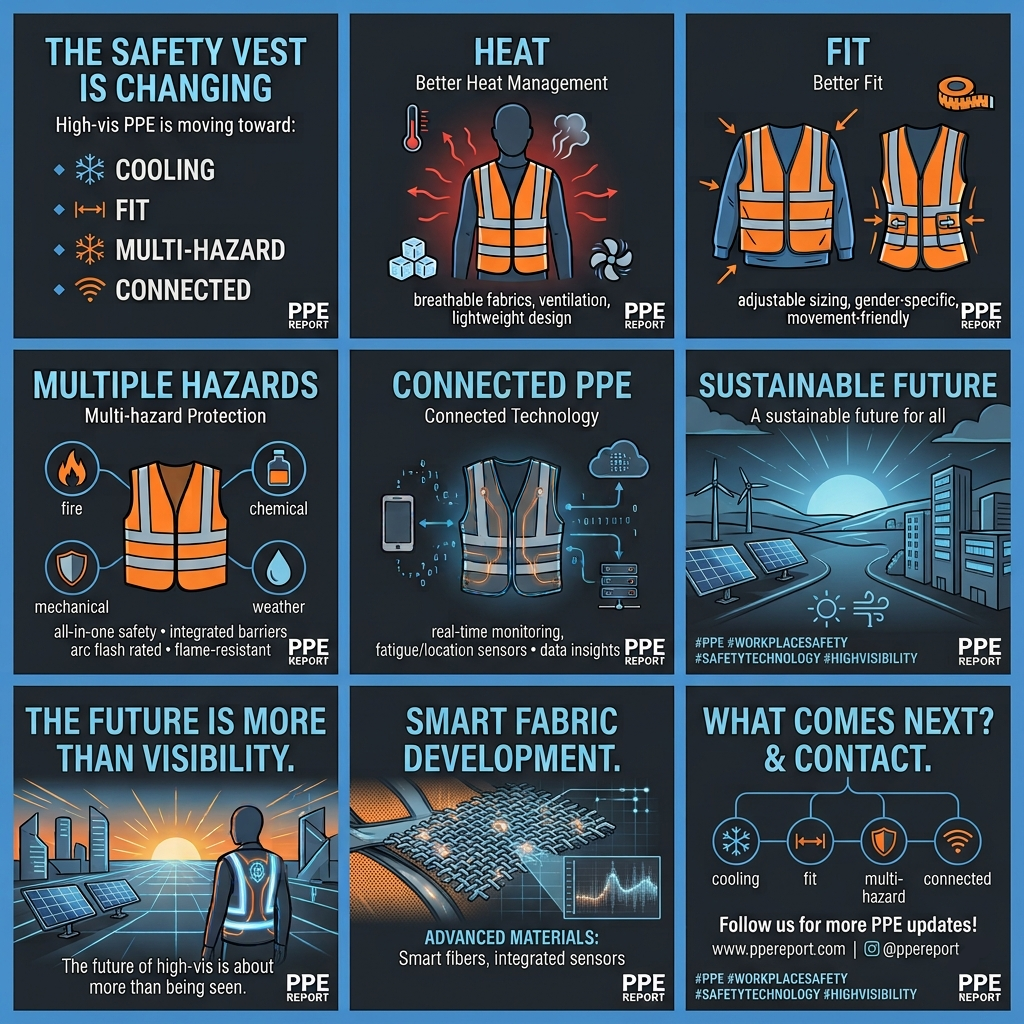
The Safety Vest Is Changing: 5 Trends Reshaping High-Visibility PPE

High-visibility safety vest
High-visibility workwear has expanded well beyond the basic vest to multi-hazard, breathable garments.

WASHINGTON / LONDON — High-visibility PPE is no longer simply about wearing a fluorescent vest. Heat exposure, better fit, multi-hazard protection and connected technology are all influencing how high-visibility workwear is being designed and selected.

From traditional vests to complete workwear

The traditional safety vest remains one of the most recognizable pieces of PPE, but high-visibility workwear has expanded well beyond the basic vest. Today, workers use high-visibility shirts, jackets, rainwear, and trousers designed for specific hazardous working environments.

Heat and breathable materials

Heat exposure is an increasingly critical consideration for outdoor workers. Lightweight fabrics, mesh construction, and moisture management are now mandatory requirements, though reducing heat retention cannot compromise visibility standards.

PPE fit and workforce diversity

Properly fitting clothing allows workers to move freely without snag hazards. The proposed revision of ANSI/ISEA 107 includes updated sizing requirements and more precise measurement guidance to better accommodate workforce diversity.

Multi-hazard garments & Connected PPE

Combining flame resistance, arc flash protection, and visibility simplifies worker gear. Furthermore, connected sensors incorporated into garments support proximity detection and worker location tracking in high-risk zones.

Source: Occupational Health & Safety, “5 Trends Reshaping High-Visibility Workwear,” Sept 2026.
Read the original report at OH&S ↗
Corporate News

U-Power Acquires KÜBLER in Major European Move

Italian footwear group U-Power acquires 100% of German workwear manufacturer KÜBLER to build a unified European head-to-toe protection platform.


Event Wrap-up

EuroSafety 2026 Wrapped Up in Tampere, Finland

The premier Scandinavian occupational health and safety event took place on 8–10 September 2026 in Tampere, Finland. The event will return to Tampere on 19–21 September 2028.


Upcoming Event

A+A 2027 in Düsseldorf

The world’s leading trade fair for personal protection, occupational safety, and health at work prepares to welcome global safety professionals on October 19–22, 2027.

PPE Report • September 2026 Issue Front Page (1)
Products • Head Protection

STUDSON Introduces SHK-2 Safety Helmet With Full KOROYD Interior

STUDSON has introduced the SHK-2, a new industrial safety helmet that replaces the EPS-based interior of its previous SHK-1 design with a fully integrated KOROYD structure. The helmet was unveiled at the 2026 NSC Safety Congress & Expo in Indianapolis and is designed for applications including construction, utilities, electrical work, roofing and oil and gas.

Full KOROYD Interior

According to STUDSON, the SHK-2 is its first industrial safety helmet to use KOROYD material throughout the interior beneath the shell. The system uses precision-welded tubes that form a crumple zone designed to absorb impact energy. At the same time, the structure creates airflow pathways intended to help dissipate heat around the wearer's head.

Unlike active cooling solutions, the SHK-2 does not use bolt-on fans or battery packs for cooling.

Designed for Type II Protection

STUDSON states that the SHK-2 has been designed and built to comply with the ANSI/ISEA Z89.1-2026 Type II+ standard, addressing both top and lateral impacts. The company also says the helmet underwent third-party laboratory testing covering penetration, environmental resistance and high-velocity impact, together with field testing involving working crews.

The Type II+ designation is particularly relevant to the updated 2026 standard, which includes additional testing related to chin-strap retention, roll-off and off-center force transmission.

Standard Brim and Full Brim Models

STUDSON plans to launch the Standard Brim and Full Brim versions together, with first shipments expected in Q4 2026. A CSA-certified version is targeted for summer 2027, according to the company.

Why It Matters

The SHK-2 highlights a broader direction in industrial head protection: integrating impact management, ventilation and wearer comfort into the helmet's core construction rather than treating them as separate features.

For workers who wear safety helmets throughout long shifts, thermal comfort can be an important part of PPE usability. The SHK-2 takes a passive approach by combining impact-absorbing material with airflow pathways in the same internal structure.

Product Specifications at a Glance
  • Product: STUDSON SHK-2
  • Category: Industrial Safety Helmet
  • Protection: Type II top and lateral impact protection
  • Interior: Full KOROYD structure
  • Models: Standard Brim / Full Brim
  • Expected first shipments: Q4 2026
  • CSA-certified version: Targeted for summer 2027
Source: STUDSON official announcement, published September 24, 2026.
Read the full announcement from STUDSON ↗
Product Technology

Graphene Enters Advanced Safety Footwear

First Graphene and Steel Blue have explored graphene-enhanced materials for safety footwear, targeting improved strength, durability, component performance, and abrasion resistance in industrial boots.

New Product Launch

HAVEP Multi Protector+ Parka

The lined multi-standard parka combines high visibility, flame and arc-flash protection with waterproof and breathable construction for demanding work environments.

Hand Protection

Milwaukee Nitrile-Dipped Glove Line with A6 Cut Protection

Milwaukee's WEAR-DEFENSE range extends nitrile-dipped hand protection through ANSI A6 cut resistance, with lightweight constructions designed to maintain dexterity.

Protective Apparel

UltraSoft FR Hi-Vis Insulated Parka

An insulated flame-resistant high-visibility parka designed for cold-weather industrial work and environments where arc-flash protection is required.

PPE Report • September 2026 Issue Products Page (2)
Standards • Head Protection

ANSI/ISEA Z89.1-2026 Introduces New “+” Designations for Enhanced Head Protection

A new edition of the U.S. industrial head protection standard introduces additional testing criteria designed to give safety professionals more information when selecting protective helmets.

The ANSI/ISEA Z89.1-2026 standard was released in September by the International Safety Equipment Association (ISEA) and approved by the American National Standards Institute (ANSI). The revision retains the existing Type I and Type II classifications but adds optional testing criteria for enhanced protection features.

What Has Changed?

One of the most visible changes is the introduction of the “+” designation.

Under the revised system:

  • Type I+ identifies head protection incorporating enhanced retention, chin-strap performance and multi-directional impact protection.
  • Type II+ identifies helmets providing Type II impact protection together with enhanced retention and chin-strap performance.

The standard also introduces additional testing related to helmet retention and chin-strap retention. Type I+ includes additional multi-point impact testing covering front, rear and side impacts.

Reverse Wearing and Visibility Markings

The revised standard also adds guidance and testing considerations for certain helmets worn in reverse.

Another terminology change concerns visibility markings. The previous HV (High Visibility) marking is updated to EV (Enhanced Visibility) in the context of head protection, reflecting that head protection is outside the ANSI/ISEA 107 high-visibility apparel standard.

Existing Compliant Helmets Are Not Automatically Obsolete

An important point for employers is that the 2026 revision does not make previously compliant head protection automatically obsolete.

Standard Quick Facts
  • Standard: ANSI/ISEA Z89.1-2026
  • Released by: International Safety Equipment Association (ISEA)
  • Key Additions: “+” designations (Type I+, Type II+)
  • Visibility Update: HV changed to EV (Enhanced Visibility)
  • Retroactive Status: Existing compliant helmets remain valid
Source: International Safety Equipment Association (ISEA), September 2026.
Official ISEA Announcement ↗
Technology • Smart Protection

Connected Safety Helmets Are Turning Head Protection Into a Data Platform

Industrial head protection is undergoing a digital evolution as manufacturers embed sensors, Bluetooth beacons, and cloud-connectivity into standard hard hats and helmets.

Connected helmets can monitor real-time impact events, worker falls, ambient temperature, and heat stress, giving safety teams instant alerts during critical workplace incidents.

"Connected helmets transition headgear from passive impact defense to proactive safety telemetry."

Beyond immediate emergency response, the aggregated sensor data allows safety managers to detect high-risk zones, near-misses, and thermal strain patterns across job sites.

EU Standards Update

EU Updates Harmonised PPE Standards (2026)

Commission Implementing Decision (EU) 2026/1279 updated references to harmonised standards supporting Regulation (EU) 2016/425, including updates for protective gloves, eye protection, and rainwear.

ANSI / ISEA

ANSI/ISEA Z87.1-2025 Eye & Face Protection

The revised eye and face protection standard adds content covering anti-fog lens assessments, optics requirements and testing clarity.

ISO Standard

ISO 13688 Protective Clothing Standard

ISO 13688:2013 remains current after its 2024 review, specifying general performance requirements for ergonomics, sizing, ageing, compatibility and marking.

PPE Report • September 2026 Issue Standards & Tech Page (3)
Market Analysis • Europe Region

Europe’s PPE Market Is Growing — But Compliance Is Becoming a Bigger Competitive Factor

Europe's personal protective equipment market is projected to continue expanding through the end of the decade, while regulatory requirements and product compliance are becoming increasingly important factors for manufacturers and buyers.

A September 2026 analysis from MarketsandMarkets estimates that the European PPE market will grow from $12.62 billion in 2025 to $16.02 billion by 2030, representing a projected CAGR of 4.88%. The research identifies workplace safety regulations and continuing compliance requirements as important factors supporting demand.

A separate September 2026 estimate from Grand View Research puts Europe's PPE market at approximately $28.4 billion in 2026, with projected growth to approximately $43.1 billion by 2033, equivalent to a 6.1% CAGR. The difference between the estimates illustrates an important point: market size figures vary considerably depending on methodology, segmentation and definitions.

Compliance Is Becoming a Market Issue

The regulatory environment provides more than a legal framework — it can directly influence purchasing decisions and market access.

In September, the European Commission reported the results of an EU-funded testing campaign involving 65 professional safety helmets purchased across eight European countries.

Of those helmets:

  • 46 samples (71%) met the requirements
  • 19 samples (29%) did not
  • eight failures were classified as serious risk
  • four were classified as high risk
  • six products were withdrawn from the market
  • two products were recalled
  • one product received a sales ban

The most common failure involved shock absorption.

What This Means for Manufacturers

For PPE manufacturers selling into Europe, compliance is therefore not simply a certification issue. It directly impacts market access, purchasing decisions, brand reputation, and product liability.

Commodity Index • Material Benchmarks

PPE Material Signals & Cost Drivers

PPE production costs remain closely tied to primary raw material benchmarks. Cotton, synthetic elastomers, crude oil, and energy prices reflect changing global cost pressures for equipment manufacturers.

Key Benchmark Indicators (September 2026)
Material / Benchmark Price Level Source
Global Cotton 88.78 US¢/lb IMF / FRED
Natural Rubber 129.50 US¢/lb IMF / FRED
Brent Crude Oil 91.08 USD/bbl U.S. EIA
EU Natural Gas (TTF) 75.93 €/MWh Elexys / EEX
EUR / USD 1.1706 USD/EUR ECB
Smart PPE & Tech Updates

MSA Expands Gas Detection & Firefighter Tech

The new cellular-connected ALTAIR io 6 combines six-gas detection with real-time connectivity. Additionally, MSA's 2026 firefighter technology portfolio debuts SCBA telemetry and the new GALLET F1 helmet.

Industrial Ergonomics

Exoskeleton Safety Frameworks

KAN's position paper addresses standardisation and safe use of workplace exoskeletons as DIN and international committees establish formal testing protocols.